The notices are in for How Shakespeare Saved My Life, which opened at the Public Theater on September 27 and runs to October 25. Jacob Ming-Trent wrote and performs the solo piece — a Red Bull Theater production directed by Tony Taccone, made with Berkeley Repertory Theatre and Folger Theatre — which tells how a homeless Pittsburgh teenager found a way through the Bard and became a classical actor. Eleven critics have filed, The New York Times among them, and the performer is barely in question anywhere; what divides them is the shape of the writing around him.
The verdict: eleven notices in the first days after opening. Four of them score it — three at three out of five and The Front Row Center at 4.7 — for an average of 3.4, and seven publish no rating at all. Most of them call Jacob Ming-Trent magnetic company, Vulture the clear exception; the disagreement is over the play he has built around himself, which the warmest notice calls a must-see and the coolest finds broad-brushed and bombastic.
What are critics saying about How Shakespeare Saved My Life?
The New York Times
"In ‘How Shakespeare Saved My Life,’ Tragedy Mingles With Comedy"
Reviewer: Elisabeth Vincentelli
"These experiences might have led to a realistic docudrama approach, but Ming-Trent takes another tack, delivering a picaresque coming-of-age-like fable à la Voltaire’s “Candide,” as told by a combination of rapper and preacher. This might explain, to put it generously, why some of the supporting characters Ming-Trent impersonates feel like broad lampoons."
Read Elisabeth Vincentelli’s full review in The New York Times
Vulture
"My play, myself"
Reviewer: Sara Holdren
"That leaves a whole lot of room for wiggling. And wiggle Ming-Trent does, painting the raw circumstances of his upbringing — a poetic addict father, a mother who kicked him out at 16, homelessness, open bigotry as he tries to pursue an acting career — with a brush so broad and hues so bold that they obscure vulnerability and uncertainty, along with the opportunity, despite the objectively rough material, for real connection. The issue isn’t that Ming-Trent owes anyone a more factual account — it’s his story to tell, but his impulse to universalize and rush forward, rather than to slow down and specify, consistently diffuses its narrative power."
TheaterMania
Reviewer: Kenji Fujishima
"Those who saw the filmed version of the Public Theater’s 2022 Shakespeare in the Park production of Merry Wives on PBS will surely remember Jacob Ming-Trent, the highlight of that production as Falstaff. But Ming-Trent has been a reliable Broadway and off-Broadway stalwart for a while, the kind of scene-stealing performer one always looks forward to seeing in a show no matter how small his role. So the opportunity to see him command the stage all by himself, as he does in his solo show, Red Bull Theater’s How Shakespeare Saved My Life at the Public Theater, already holds immense promise going in. Not only does he fully live up to that promise, but it turns out he’s a solid playwright as well."
Time Out New York
“Jacob Ming-Trent has come to preach salvation in his vivacious memoir”
Reviewer: Raven Snook
A perennial scene-stealer in ensemble work—his gleefully lustful turn Falstaff in Merry Wives was particularly memorable—Ming-Trent is a captivating performer. He even does some endearing bits of crowd work: asking our names, wooing a lady with the Bard's words, having us shout out "play on!" in lieu of "amen!” at pivotal points of the story. But as a writer, Ming-Trent sometimes still seems to be finding his footing. Although Alexander V. Nichols' illustrative projections help ground each section, the journey sometimes feels disjointed.
New York Theatre Guide
“A moving testament to the Bard’s power”
Reviewer: Allison Considine
Ming-Trent is a high-energy explosion of joy — a striking contrast to the autobiographical material, which begins with his father going to jail when he was a child and includes chapters of homelessness, drug use, and fraught family tension. Under Tony Taccone’s direction, Ming-Trent’s playfulness balances the tough truths of his story, while Shakespeare fits alongside hip-hop to create a cohesive production. Video projections by Alexander V. Nichols add to the show’s kinetic energy, and colorful typefaces, graphics, and illustrations help set the scenes.
Read Allison Considine’s full review at New York Theatre Guide

New York Stage Review
“Theater as Testimony”
Reviewer: Frank Scheck
It’s all a little exhausting, frankly, and indicative of how the performer tries too hard to inject frenetic energy and audience participation into his moving tale. He found himself homeless at age 16 after his drug-addicted father left home and his unloving mother subsequently threw him out of the house. He got on a Greyhound bus to New York City to pursue an acting career after discovering a love of the Bard in a class taught by his school’s football coach.
The Front Row Center
Reviewer: David Walters
There’s a real sense of inclusion, of acceptance, and of connection between player and audience from the get go. Ming-Trent is a magnetic, generous performer. He is funny, raw, intellectually nimble, and he works the room like a preacher and a teacher at once. You feel welcomed into his story, not lectured to by it.

Culture Sauce
“Treats the Bard as life coach”
Reviewer: Thom Geier
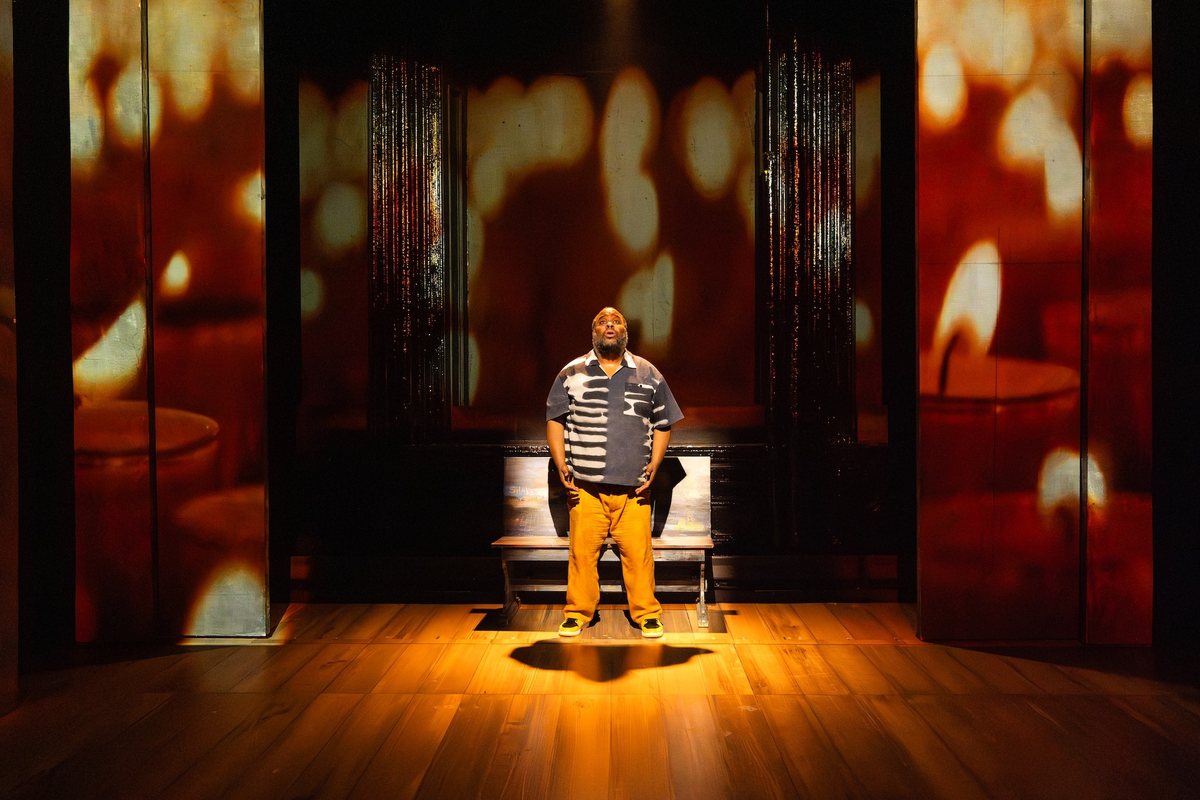
It’s an inspiring and sometimes exhausting tale — one that is amplified by Alexander V. Nichols’s projections on Takeshi Kata’s simple but effective set of sliding panels. Under Tony Taccone’s direction and Tiffany Rachelle Stewart’s movement direction, Ming-Trent moves nimbly about the stage with feline stealth, engaging the audience repeatedly in call-and-response moments that help soften the blow of the trauma that’s just been exposed. “Play on?” he asks, and we’re invited to shout back, “Play on.”
Lighting & Sound America
Reviewer: David Barbour
Then again, this crowded hour-and-a-half moves so quickly from crisis to crisis that it all becomes hard to absorb. At times, Ming-Trent seems like a docent, hustling us through the exhibits in his own personal museum of trauma. It doesn't help that some sections have clearly been fictionalized, leaving one to wonder what is true and what is fanciful. (That story about being chased down the street by an angry white mob, demanding he play Othello? Hmmm.) Curiously, his moment of salvation comes not from Shakespeare but from embracing James Baldwin's famous words: "It took many years of vomiting up all the filth I'd been taught about myself, and half-believed, before I was able to walk on the earth as though I had a right to be here."
Read David Barbour’s full review at Lighting & Sound America
New York Theater
Reviewer: Jonathan Mandell
What is undeniably real is Ming-Trent’s infectious energy and humor, which he firmly established as a performer in Broadway musicals (Gypsy, Shrek) and yes, as a Shakespearean actor, most notably in “Merry Wives” at the Delacorte in 2021. His new show features a generous supply of Shakespeare’s verse, along with some original raps, as he exuberantly imparts what is probably a mix of tall tales and true tales —sometimes hard to tell apart, not least because both are so engaging.
Off Off Online
Reviewer: Deirdre Donovan
"Ming-Trent doesn’t immediately divulge that he has saved the role of cheerleader for his newly appointed “congregation”—so named because we have “chosen to congregate here today.” Breaking the fourth wall, he introduces himself as “Jacob,” asks audience members to greet the person next to them, then instructs us to call out “Play on!” whenever he points to us. After rehearsing the response, he beams, “You got it!” The moment makes the magic of theater feel like something audience members are creating together."
Production photographs by HanJie Chow.
More from the New York season: what the critics made of The Invention of Love at Theaterlab, and Max Wolf Friedlich’s The Holes at the Wild Project.
How Shakespeare Saved My Life runs at the Public Theater, 425 Lafayette Street, through October 25.