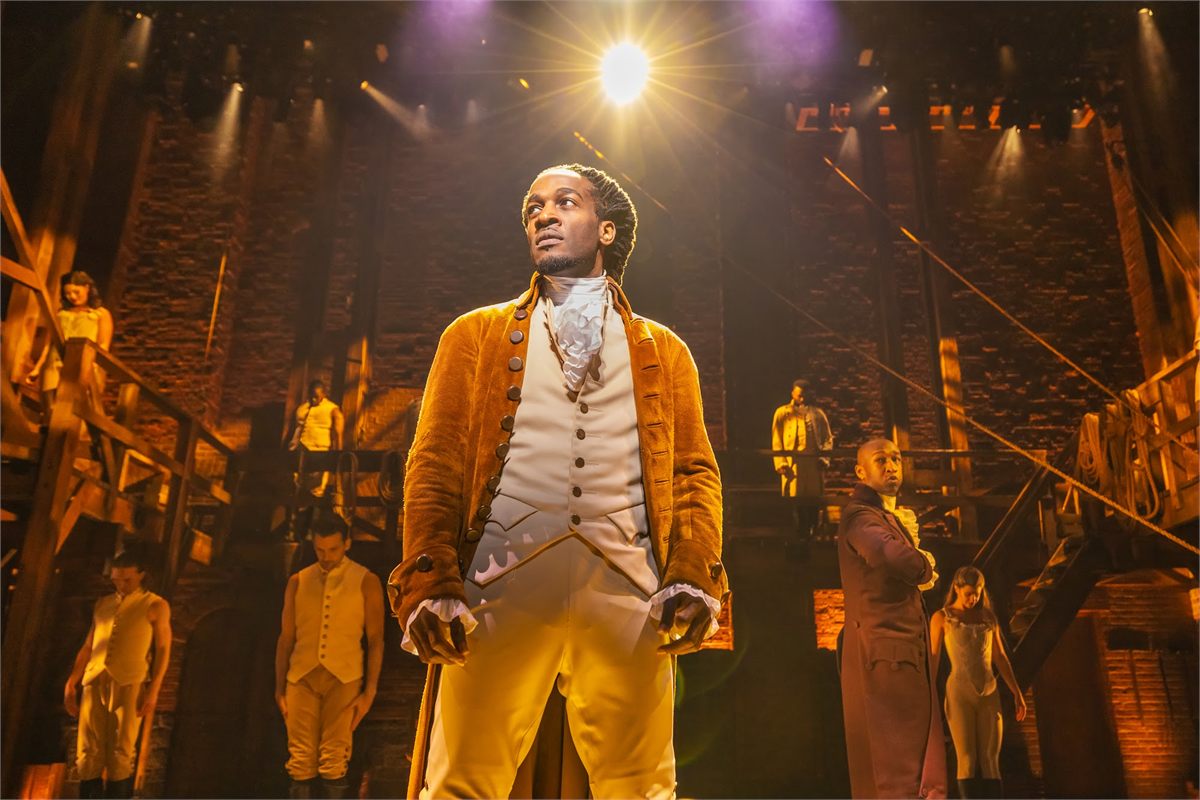
 Hamilton is a musical built out of a 2004 biography, and much of what sounds invented in it is not. Here is the history behind the orphan from Nevis, the Schuyler sisters and the duel at Weehawken, and the places where Lin-Manuel Miranda chose to bend the record.
A biography taken on vacation
The show started with a book. In 2008, while he was starring in his own In the Heights, Lin-Manuel Miranda took Ron Chernow’s 2004 biography Alexander Hamilton on a vacation to Mexico. On May 12, 2009, invited to a White House evening of poetry, music and the spoken word, he was expected to sing something from In the Heights and instead performed an early version of what became the opening number. Chernow went on to serve as the production’s historical consultant. Hamilton began previews at the Public Theater on January 20, 2015, opened there on February 17, and transferred to the Richard Rodgers Theatre, where it opened on August 6, 2015. It won 11 Tony Awards from a record 16 nominations, and the 2016 Pulitzer Prize for Drama.
The orphan from Nevis
Alexander Hamilton was born on Nevis, in the British Leeward Islands, on January 11 of either 1755 or 1757; historians still disagree about the year. His mother, Rachel Faucette, died of yellow fever in February 1768 on St. Croix, where the boy was already clerking for the import-export firm of Beekman and Cruger in Christiansted. A hurricane struck the island in late August 1772, and the letter Hamilton wrote to his father about it was printed in the Royal Danish-American Gazette through the local clergyman Hugh Knox. A collection raised by Knox and the merchant Nicholas Cruger paid his way to New York, where he arrived in 1773 and went on to King’s College, now Columbia University. The opening song squeezes all of that into a few minutes, and the outline holds.
Washington’s right-hand man
On March 1, 1777, Hamilton was made a lieutenant colonel and joined George Washington’s staff as an aide-de-camp, a post he held for four years. What he wanted was a field command, and he finally got one: at Yorktown, on October 14, 1781, he led the bayonet charge that took Redoubt No. 10, and the British surrendered five days later. “Right Hand Man” and “Yorktown” stay close to the record (the Gilder Lehrman Institute’s chronology is a good place to check the dates).
The Schuyler sisters, as they really were
Hamilton married Elizabeth Schuyler on December 14, 1780, at her family’s mansion in Albany. This is where the musical takes its boldest liberty. In “Satisfied,” Angelica meets Hamilton first, steps aside so her sister can have him, and only later leaves for London with a husband. In fact Angelica had eloped with the British-born merchant John Barker Church in 1777, three years before the wedding, so she was already married when Hamilton came courting Eliza. The Churches lived in Paris and then London from 1783 and came home to New York for good in 1799. Her letters with Hamilton are affectionate and quick-witted; no evidence shows that they were ever more than that. And Philip and Catherine Schuyler raised more children than the three sisters the show puts on stage.
Laurens, Lee and the room where it happened
Some of the unlikeliest moments are true. John Laurens did duel Charles Lee, on December 23, 1778, just outside Philadelphia, after Lee had disparaged Washington, and Hamilton was one of the seconds who stopped it once Laurens had wounded Lee. The show has Laurens die after the war is over; in fact he was killed on August 27, 1782, in a minor skirmish at the Combahee River in South Carolina, ten months after Yorktown and before any peace had been signed.
“The Room Where It Happens” rests on a real dinner, held on or about June 20, 1790, at Jefferson’s lodgings in New York. Madison agreed not to block Hamilton’s plan for the federal government to assume the states’ war debts, and the permanent capital went to the Potomac. The only first-person account is Jefferson’s own memorandum, written some time afterward, which is precisely Burr’s complaint in the song.
The Treasury, the pamphlet and two duels
Before taking office, Hamilton wrote 51 of the 85 essays of The Federalist, with James Madison and John Jay; the first appeared on October 27, 1787. He was appointed the first Secretary of the Treasury on September 11, 1789, and served until January 31, 1795. In 1797, accused of misusing public funds, he cleared himself by publishing a full account of his affair with Maria Reynolds, the document the show calls “The Reynolds Pamphlet.” When Jefferson and Aaron Burr tied in the Electoral College in the election of 1800, he backed Jefferson, his longtime adversary, over a man he considered unprincipled.
The deaths follow the record, too. His eldest son, Philip, was shot on November 23, 1801, at Paulus Hook, New Jersey (today Jersey City), in a duel with the lawyer George Eacker over a speech attacking his father, and died the next day at 19. On July 11, 1804, Burr shot Hamilton at Weehawken, New Jersey; he died in Manhattan the following day.
Who tells her story
The finale hands the evening to Eliza, and that is faithful as well. Elizabeth Schuyler Hamilton outlived her husband by half a century. She co-founded the Orphan Asylum Society in New York in 1806, helped Dolley Madison and Louisa Adams raise money for the Washington Monument, and died in Washington, D.C., on November 9, 1854, at 97.
Seeing it now
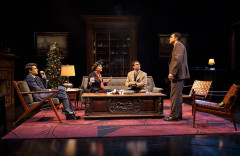
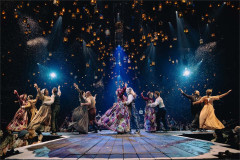
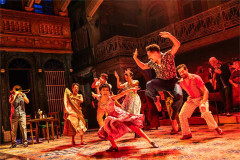
The current Broadway company, led by Marcus John in the title role, was photographed this month in a new set of production photos, and the original cast album logged its 500th week at No. 1 on Billboard’s Cast Albums chart in October. Book tickets for Hamilton at the Richard Rodgers Theatre.