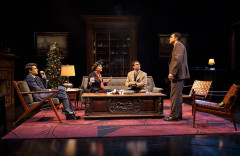
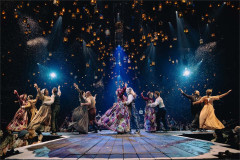
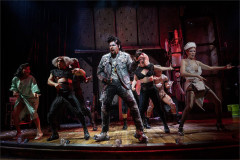
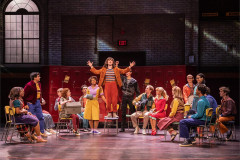
 “Broadway” sounds like a street, and partly it is. But when theater people use the word they mean something narrower: a set of 41 theaters, defined by size, by use and by an official list. Here is how that list works, and where Off-Broadway and Off-Off-Broadway fit around it.
Broadway for Beginners is our series for anyone planning a first trip to New York theater, or just wondering what the words mean.
It is about the building, not the show
A show is “on Broadway” because of the theater it plays in. The clearest written definition is in the Tony Awards rules for the 2025–26 season, which set three tests. An eligible Broadway theater must “have 500 or more seats,” must “be used principally for the presentation of legitimate theatrical productions,” and must be “deemed otherwise qualified” by the Tony Awards Administration Committee.
That committee keeps the official list, printed in the rules as Exhibit A, and it names 41 theaters. A building joins it only by the committee’s decision, one season at a time. Lincoln Center Theater gives the same count, calling its Vivian Beaumont “one of 41 Broadway theaters in New York City.”
The 500-seat line has a footnote
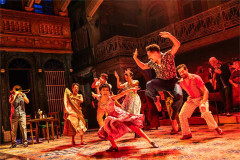
The number has not always been 500. The rules record that the minimum went up from 499 to 500 seats for the 1989–90 season, and that a theater already on the list keeps its place as long as it does not cut its capacity below what it offered the public on June 1, 1989. One house carries that asterisk: the Helen Hayes at 240 West 44th Street, known today as the Hayes Theater, where The Fantasticks is playing now (we gathered eight things you might not know about it).
Most of them are not on Broadway
The street gives the district its name, but few of the 41 sit on it. Going by the addresses in the Tony list, six do: the Marquis, the Palace, the Gershwin and Circle in the Square (which share 1633 Broadway), the Winter Garden, and the house named simply the Broadway. All the others but one are on the cross streets of the West 40s and 50s, from the Nederlander on West 41st Street to Studio 54 on West 54th.
The exception is the Vivian Beaumont, at 150 West 65th Street, which Lincoln Center Theater describes as the only Broadway house outside the Times Square area.
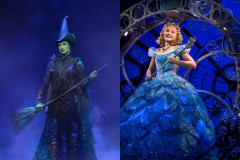
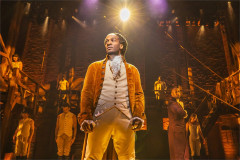
To put shows to a few of those names: Wicked plays the Gershwin, The Lion King the Minskoff, Hamilton the Richard Rodgers, and Stranger Things: The First Shadow the Marquis.
Off-Broadway: smaller, and outside the district
Off-Broadway is a matter of size and place. The Actors’ Equity Off-Broadway agreement covers theaters with “fewer than 500 seats in the borough of Manhattan” that are not in the “Broadway District,” and sorts them into five categories by seating capacity. The Off-Broadway League, whose members own, run and produce in those theaters, puts an Off-Broadway house at 76 to 499 seats.
Two companies we cover often at this tier are The Public Theater, where we are selling The Curious Case of Benjamin Button, and Playwrights Horizons, where Degenerates begins performances on December 15.
Off-Off-Broadway: the smallest rooms
Below that sits Off-Off-Broadway, the name for the city’s smallest stages. Equity has a separate set of rules for them: its New York City Showcase Code is “for use only in New York City in theatres of 99 seats or fewer.” Here at News From Broadway, anything under 100 seats goes in our Off-Off-Broadway News section.
Why the label matters
For you, the tier is a rough guide to the size of the room. For the show, it decides which prizes it can compete for: under the Tony rules, a production must officially open in a theater on the Exhibit A list to be eligible. The awards, and the other prizes around them, get their own installment later in this series.
Next in Broadway for Beginners: the parts of a Broadway house, from the orchestra to the balcony.